- ISCOWP E-newsletters
Good news! You have completed the $18,750 Feed the Cows Campaign and the $25,000 Matching Gift Challenge! Thank you, everyone! Eve...

Today is the birthday of the most wonderful cowherd boy, Krishna. He is glorified and worshipped by devotees worldwide as the merciful God who spent his childhood herding, protecting, and loving cows. Charitable acts on this day, especially to cows, bestow significant blessings upon the giver. Today, you can feed cows, complete the Feed the Cows Campaign, double your gift’s value, and receive blessings!
The last two e-newsletters explained that, due to the potential scarcity of hay and rising hay prices, we felt it was prudent to stockpile hay earlier this year for the 2026-2027 winter. Our goal is to fill the barn, which costs $18,750.00. Due to your generosity, $15,429.71 has been donated! Our heartfelt thanks to everyone! Only $3,320.29 is needed to complete the campaign. On this auspicious day, let’s complete the campaign and fill the barn! And don’t forget, your gift will be matched up to $25,000.00!
You can help purchase hay for the ISCOWP herd for a day, a week, or a month.
One bale costs $75.
$75 to feed the herd of 23 cows for a day
$525 to feed the herd of 23 cows for a week
$2,100 to feed the cows for a month
Or you can donate whatever you can.
Look to our Donation page and our next e-newsletter for campaign update.
It has been raining almost every day, but according to the US Drought Monitor, we are experiencing drought conditions. The extent of remaining drought across Florida in late August was extremely unusual, as the wet-season rainfall has been unable to fully erase the severe deficits accumulated during the winter and spring. In addition, the high temperatures scorched the earth until the next rainfall.
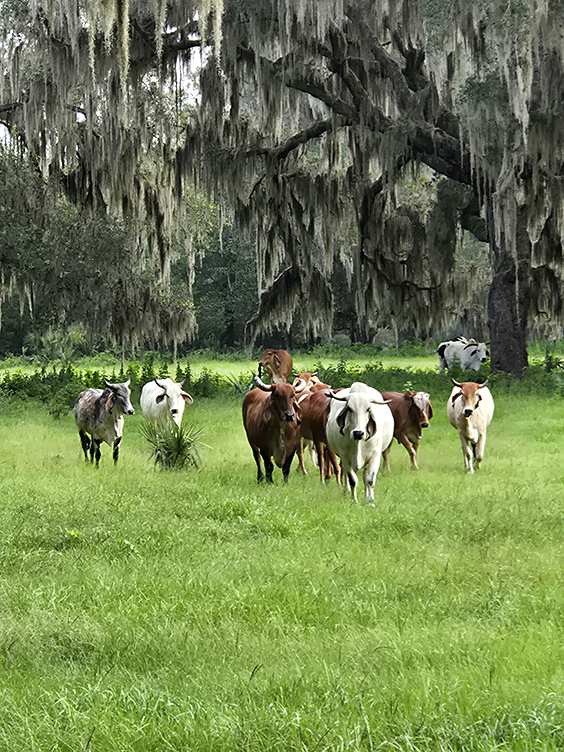
We have discovered that if we dig over an inch down into the soil, the earth is dry and hot. The grass and all vegetation have been growing, so it is easy to think we are not experiencing drought. We are praying the rains continue.
Cows possess a truly incredible visual range that makes them almost impossible to sneak up on in an open field. Because their eyes are located on the sides of their heads, they have panoramic vision covering nearly 360 degrees. This allows them to see predators coming from almost any direction without even moving their heavy heads.
The only real blind spot they have is a small area directly behind them, which is why they get spooked easily. Their horizontal pupils are specifically designed to scan the horizon for any sign of movement or danger. It is like having a built-in security camera system that is constantly monitoring the perimeter of the entire herd.
While their peripheral vision is elite, they struggle with depth perception for objects that are very close to their noses. This is why a cow might hesitate or stop abruptly when she sees a shadow or a puddle on the ground. To them, a simple change in ground color can look like a bottomless, dangerous pit.
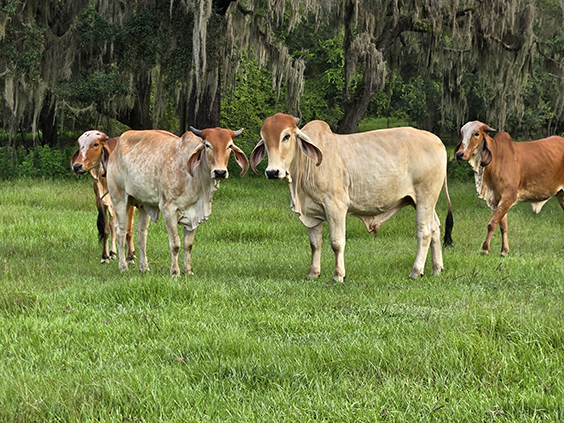
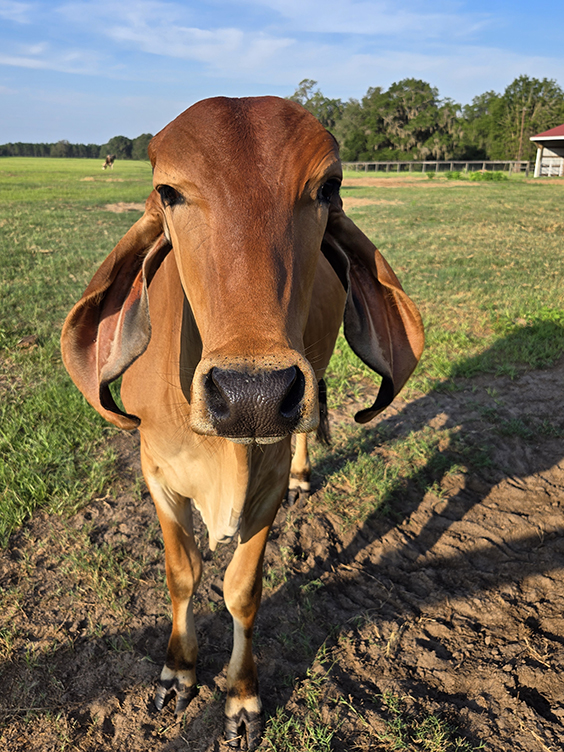
Interestingly, while they have amazing range, they don’t see the world in the same vibrant colors that humans do. They are dichromatic, meaning they mainly see variations of blues and yellows, while red looks more like a dull yellowish-gray. This completely debunks the myth that bulls are enraged by the color red during a traditional matador’s performance.
In reality, the bull is reacting to the aggressive movement of the cape rather than the specific pigment of the fabric. According to the American Society of Animal Science, movement is the primary trigger for their defensive instincts. Knowing these facts about cows helps us understand why they react to the world with such caution.
Next time you see a cow staring at you, remember she is processing a massive amount of visual data at once. Her eyes are finely tuned instruments of survival that have evolved over millions of years to keep her safe. It is a perspective of the world that we, as humans, can hardly even begin to imagine. Fact Wonders.com